Alarming
Alarms for every kind of limit
Each channel can carry an instant alarm and an over-time alarm, with four levels - low-low, low, high and high-high - and hysteresis, so alarms clear cleanly instead of flapping.
Alarm types
-
Instant threshold
Judges each new valid reading as it arrives, on every channel, including pore pressure.
-
Moving average over time
Judges the mean of a trailing window of 20 to 360 minutes, on environmental channels such as turbidity, with NS 9433:2017 in mind.
-
Percentile over time
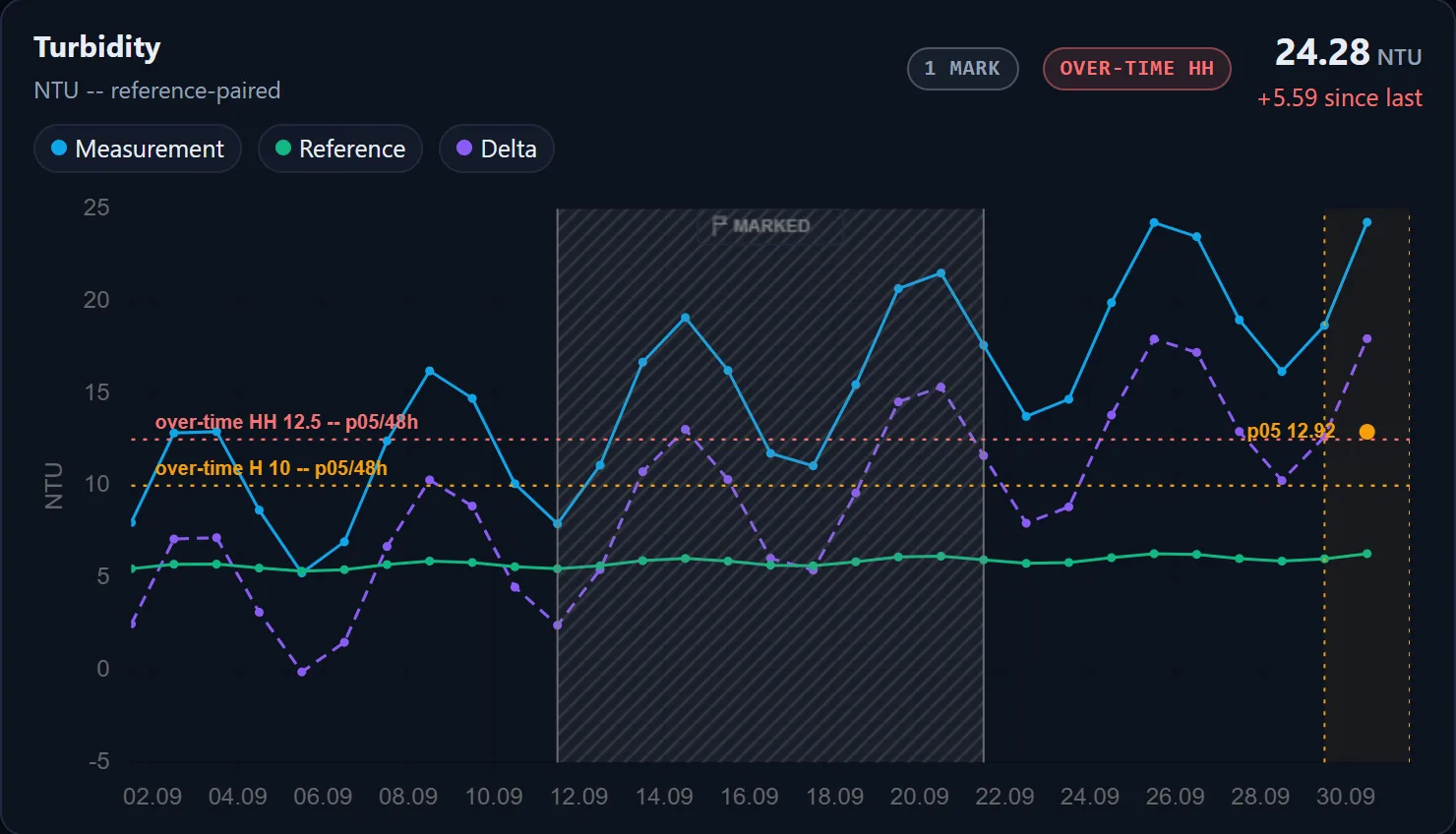
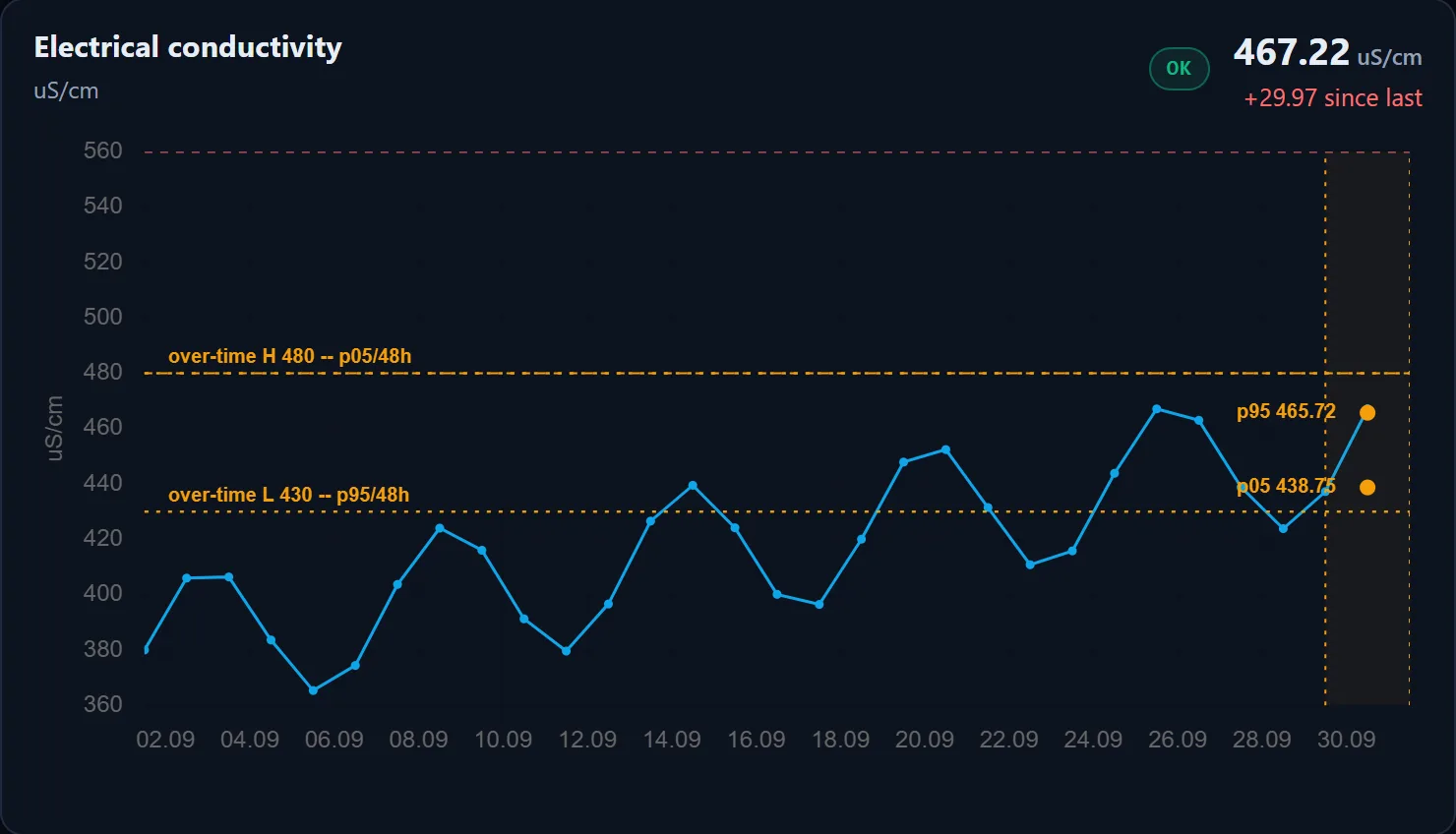
Judges the 5th percentile against high limits and the 95th against low limits, so an alarm needs an exceedance that persists across the window. Single spikes and sensor noise do not raise it.
On the chart
See what the alarm sees
Over-time alarms are drawn as a gliding evaluation window on the chart, with their limits as reference lines - here on turbidity, paired with an upstream reference.
Alerts
SMS and email
Notifications on escalation and on recovery, by SMS, email or both, chosen per contact. Contacts do not need a user account.
- SMS delivery reports are tracked, and transient failures are retried automatically.
- Recovery notices can be switched off per alarm.
System alarms
The installation watches itself
Administrators get system alarms by email when:
-
Something goes silent
A gateway, node or channel stops reporting.
-
Hardware health drifts
Node battery, gateway supply voltage, mesh signal strength and link cost, or gateway disk usage cross their limits.
-
Data or delivery fails
A channel keeps returning invalid readings, ingest health turns critical, or SMS delivery fails.